
This past year has been difficult; I won’t sugarcoat it. But, it’s also been a bit of a revelation. I was forced to face some things about myself that I’ve long ignored, though of late, I’d been far less successful than previously.
I’ve always been an emotionally sensitive, some might say fragile even, person. I didn’t need a therapist to tell me (but they did) that some of it, probably a lot of it, stemmed from my childhood. Adoption, two divorces (4 “mother figures”), and a family in near-constant worry over a son (my brother) who, at any moment, could and would do something almost unimaginable in the early 80s, tend to weigh on a kid.
In my case, I believe nature is partly to blame, but nurture more so because my emotional state evolved over time. I’ve always been independent; in fact, I prided myself on it. Once I left home, I never asked my family for anything–nor did I receive anything. I returned home a few times, but during the first leave I took to visit my family after joining the Air Force, my dad and step-mom announced they were divorcing. After that, there just didn’t seem like much to come home to. So I became stronger and more independent. I made my own decisions; saved my own money, and got a dog. I was good. At least, that’s what I told myself.
But there was always a simmering sadness just below the surface that bled through any time someone showed me kindness. I wouldn’t say that has caused problems, necessarily, but it has created situations where I’ve been unable to control my visible emotions in front of someone I should, like a manager.
The flip side of being that emotionally on-edge is that those situations indelibly lodge themselves in my memories and for those people whose kindness affected me, they remain some of my favorite people, whether they know it or not. To this day, decades later in some instances, I feel a fierce loyalty to them that they’ll never know.
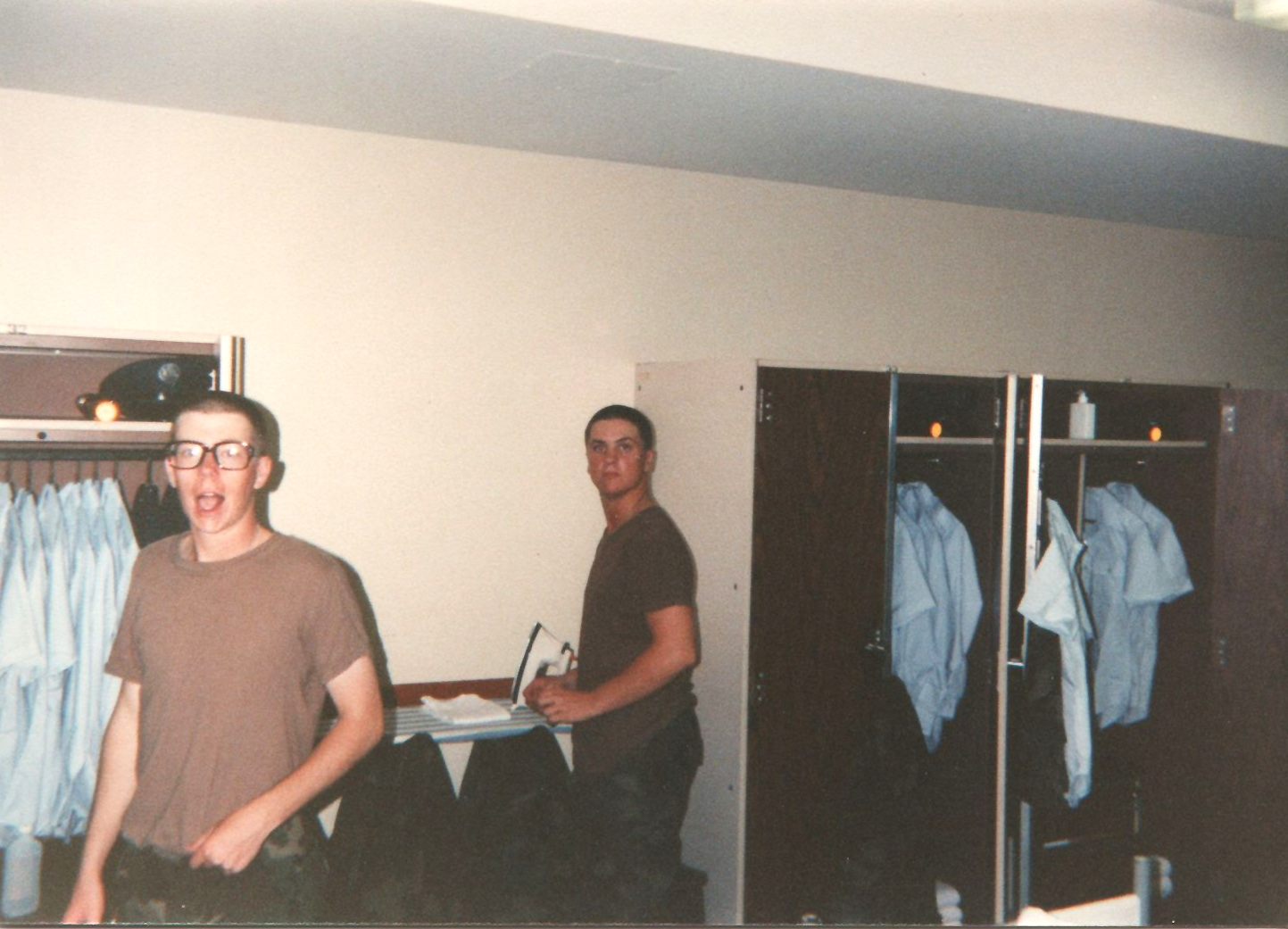
Thinking about this, I’m reminded of the first time I became self-aware that I perhaps had some emotional turmoil. I’d just left Air Force Basic Training in Texas. We’d flown into Biloxi, MS, and caught the shuttle to my Tech School at Keesler Air Force Base.
Now, for this story to make sense, you have to understand something about Basic training: It’s six weeks of mental misery. Everything they can do to try and break you, they will do. Recruits are constantly yelled at and put down, and even when you’ve tried your hardest and done your best, they’ll tell you it wasn’t; that it was a piss-poor effort and you’re the sorrier for having even tried. At least in my experience, not a single word of comfort was ever offered by those in charge.
To reinforce a pending state of worry and constant fear, each recruit is required to carry around three small 4×6″ forms called DD316s, at all times. To be caught without three, even if you’d had one taken from you and not yet had a chance to return to the dorm and get another, was itself a violation, resulting in the generation of another DD316 black mark on your training.
The purpose of these forms was to provide a physical record of your screwups. Any Drill Instructor, at any time, could demand one from the recruit, typically in response to some misbehavior or failed instruction (e.g., improperly shined shoes), whether real or imagined. Although the exact number of collected DD316s that it took to get you “washed out” was never stated explicitly, the idea was that any recruit who generated enough of these forms would have to start Basic all over again. There was an unspoken acknowledgment among recruits that having to start Basic over was a non-starter, so either you made it the first time or you were “out.”
Suffice it to say, nothing you did was ever good enough even if you knew in your heart it was the best you could do. And every recruit had more than a few DD316s taken from them; that’s just the way it is. The program is designed to break those who are not strong enough, mentally.
I remember one evening about 2/3 through Basic. I was, at the time, Flight Leader and had three other Squad Leaders to help me. We were called for by our Drill Instructor and told to come to the bottom floor of the dormitories. Within minutes, the four of us arrived at the room we’d been instructed to visit. We knocked; the door was opened, and we four filed in quietly, unsure of why we’d been summoned.
The room was dimly lit and I immediately noticed four Drill Instructors in the room, some standing; others sitting. Immediately, I also heard someone crying. Over in the corner was one of our fellow recruits. He’d been missing all day and no one knew why. We’d all assumed he’d reported to the medical clinic and would return when he was cleared. Being July in Texas, heat sickness and “crotch rot” (severe blistering in your nether parts due to constant sweat and rubbing) was rampant.
But it quickly became clear this recruit was not physically ill. As he stood there crying–wailing even–two of the Drill Instructors stood around him yelling. They called him names, threatened to throw him out of Basic, and generally berated him mercilessly. We four Recruits were told that this particular Recruit was not mentally strong enough for the Air Force. And as we stood there, dumbfounded and frankly, unnerved, one of the Drill Instructors asked us, “Would you want him next to you in a foxhole? Would you want to trust your life to someone who can’t even handle being yelled at?”
The truth was, we wouldn’t want to. As bad as it sounded then and now, it was the truth. And at that moment, I realized that a lot of what we were enduring in Basic was a game. And it wasn’t. But, the winners were the ones who could last the longest. Since that time, I’ve worked hard to keep my feelings in check because the world can be a cruel place, and I wasn’t about to give it any more ammunition.
I’ve thought back on that episode many times over my life. I’ve wondered if it was real or staged. I’ve even wondered if it really happened or if maybe I made it up to help me get through boot camp. I’m confident it happened, but I’m also confident there was more going on there than we were told. Perhaps they’d found out this particular youth was an illegal. I don’t know. His last name was common to the Philippines and it was clear he wasn’t from the heartland of the U.S.
In the end, nearly all of us passed our tests and survived Basic, though I didn’t score nearly as well on my final graded exam as I’d expected. But even after I graduated, after packing up my meager belongings and heading to the bus that would take us to the airport along with my fellow Airmen, did we get a kind word from our Drill Instructor? A parting comment about how proud he was of us, perhaps? No. Instead, he stood at the door to the bus and as each Airman boarded, he punched us on the arm.
Go figure.
So as I arrived at my next temporary duty station in Mississippi, I had no expectation of it being any different. Still pretty much a young, dumb kid, I’d resigned myself to the fact that this was my new life, for better or worse, and there was nothing I could do but try to get through it. But, at least I was on my own and self-sufficient. That was worth something.
There were approximately six of us new recruits just out of Basic on the plane arriving together and heading to Keesler where we would train for anywhere from 2-9 months for our next job in the Air Force. A few of us knew each other, but not all. We found and boarded the shuttle, each quietly staring out the window, afraid to say anything or look at anyone lest we draw negative attention. It was September; raining, and humid as it always is from April through October in the South.
Getting off the bus, I grabbed my green duffle and was met by a youngish, female Airman. Probably in her early 30s, she had a kind face and seemed completely non-threatening. Smiling, she offered a “Welcome” and beckoned for us to follow her inside where we were instructed to drop our bags and take a seat in a small room with schoolroom-style desks.
After introducing herself, she began telling us what we would be doing that day–mostly paperwork– before getting our room assignments and instructions for starting our first day of class. I remember sitting there and looking around the room, mentally categorizing what I might be called on to do or say so I’d be prepared and not get in trouble for saying something dumb.
After some time, she mentioned something about lunch, saying they were prepared meals that come in a box. She joked that everyone called them, “Boxed Nasties” and I remember thinking that this was the first bit of non-crude humor I’d heard in more than a month and a half. It was also the first inkling I had that maybe, just maybe, things were going to be a little less terrible.
As we sat and ate, she tried to goad us into conversation but it was clear we were all still very shellshocked and distrustful. In Basic, recruits weren’t allowed to address anyone not a recruit unless or until you were addressed first. But, as the minutes passed and it became more apparent she wasn’t going to start yelling and no one was going to come in banging on a garbage can and shining flashlights in our eyes, we all began to loosen up and talk.
I don’t remember who, but one of us told her how strange it felt being there and her being “nice.” She laughed and said it’s normal and that everyone who arrives there after Basic feels the same. She assured us the “Basic Experience” was over and Tech School was going to be a lot more like the regular Air Force. There would still be things we were required to do, but the days of being fearful of everything and everyone was over.
Somehow, I was able to control my emotions that day, but inside I was a mess. I wanted to melt out of my chair, scooch over into a corner, and just ball my eyes out. I didn’t, but I wanted to. And the strange thing is, I’d never felt that way before. Certainly never at home. It was almost as if now that I was on my own, and knowing full well that my family couldn’t come help–or hurt–me, it was OK to “feel.”
In the years since, I’ve learned a great deal both about myself, and my childhood. Some things I knew; some I didn’t. And some things, I’m sure I just repressed. It’s taken an emotional toll that I hadn’t fully realized until the last few years, and only even more recently did I seek out help.
I’m happy to say that I’m doing much better. Truth be told, I haven’t felt this “even” in decades. It’s unfortunate it took me this long to seek help because I’m confident that some of the decisions in my life that have been the most impactful–usually negatively in some way–were in no small part influenced by a mind that I can only look back at now and question.
We Gen-Xers are an independent lot. We pride ourselves on having survived childhoods that saw some of the most impactful societal change in the last 100 years. But, the truth is, even the strongest of us need help sometimes. If anything I’ve written here rings a bell, I urge you to find someone to talk to. Get some help, or at least find out if you need it. If a first step would be talking with someone a little less “professional,” my email’s always available.

 Postulates & Pastimes